Woods and Plastics
09 December 2019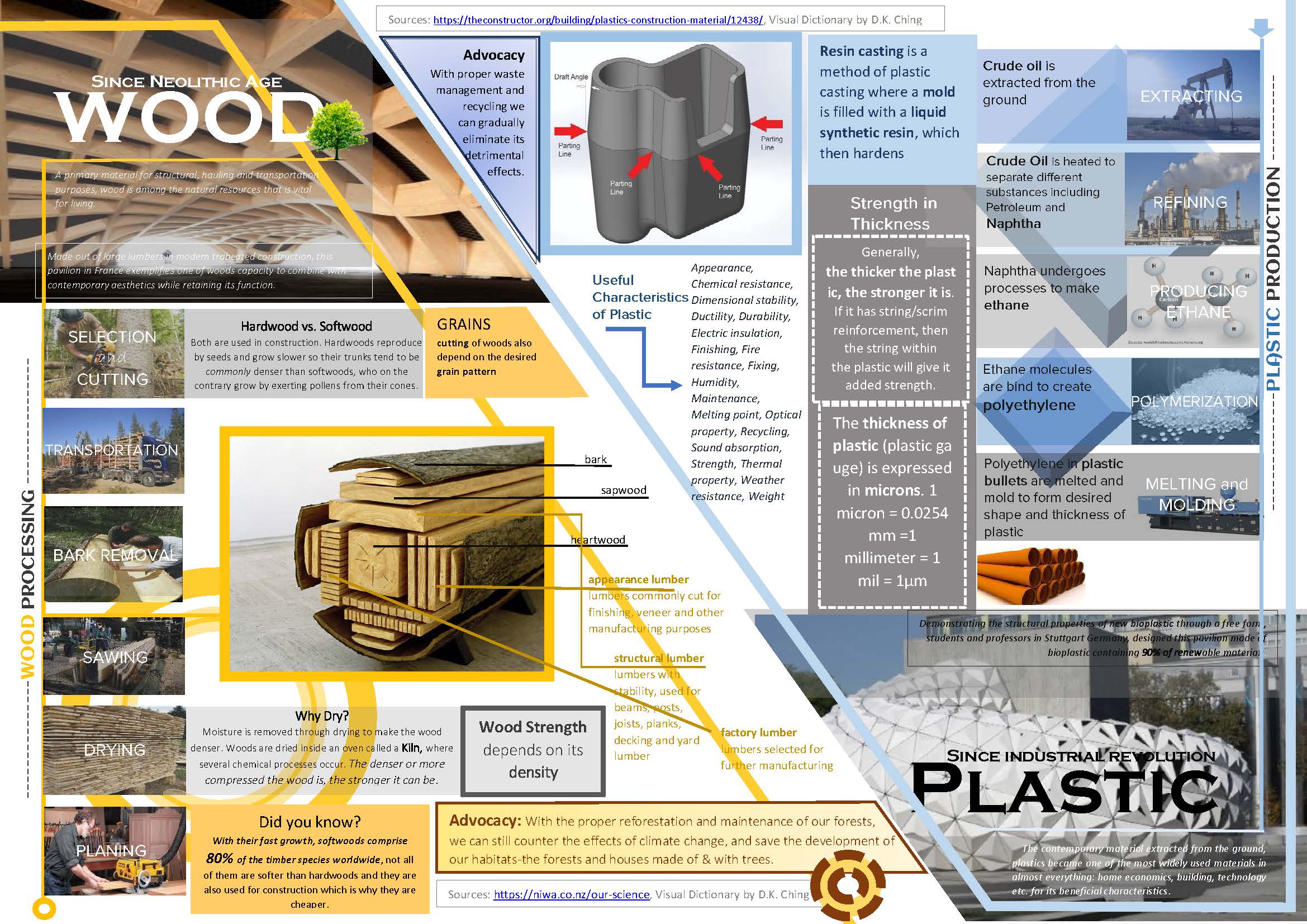
Wood
Timbers commonly the hardwood are selected from the softwood and harvested from large forested areas where their vertical growth is specifically needed for cutting them to parallel pieces called logs. Logs' barks are scraped off, and the large remaining enters large cutting machines that slice them while rotating creating a sheet of plywood, or vertically cut and shape them creating lumbers and boards. Ready for process, these products enter a lumber production factory where their moisture are sip out, and their strength are tested by their tightness.
Other sub products are also made, such as the selection and sorting of the structural from the ornamental. In the pre-production, hardwood with greater strength, made to withstand enormous force or pressure are processed to become structural lumbers: such as the ones used for different types of posts, others which are used to the creation of various beams, and some, - platforms in ply that are laminated with a number of layers. On the other hand, softwood becomes finishing for walls, such as the lumbers that are used for boards, and others become material for tiny wooden furniture, and cornices for corners.
Wood is one natural resource discovered as a building material along with stones and mud-bricks. Wood is an important part of living since it provides a home not only for human establishment but also for the habitat of other significant parts of the ecosystem. Moreover, in aesthetics, wood also provide a cozy atmosphere, and accentuates buildings with a natural highlight.
Plastic
Plastics were first used by early native Americans, that was naturally extracted from a tree trunk and hardened to a ball. Scientists continued their study and developed the first usage of plastics from the harvested crude oil. This marks the start of using plastic in almost all industries of living.
Plastics today follow different life cycles that commonly pollute our environment, yet started with commonly one. Plastics came from oil found underneath the surface. First, seismic and geological mapping finds the source where crude oil is abundant. After which, large machines extract this oil in a very careful way for these are highly flammable. Crude oil is then transported to oil refineries, where different uses of it separates from each other through evaporation: asphalt, petroleum for fuel, Naphtha etc. Ethane is one primary unit of plastics, and Naphtha is one of its primary sources. Ethane is extracted from Naphtha under several chemical processes. Ethane, then, undergoes polymerization, where building blocks of it are combined to form polymers and then molds them into strings of plastic which is then converted to tiny bullets called plastic pellets. These plastic pellets are transported to different companies manufacturing it to their desired form and thickness.
Plastics are convenient for they contain very useful characteristics: changeable appearance and color, chemical resistance, dimensional stability, durability, electric insulation, fire resistance, moisture resistance and weather (if applied with a surface solution), recyclable, sound absorption, and thermal property. Through this, various uses of it were applied in building technology: metal tubes replaced with plastic in water supply, electric insulation made with plastic for higher resistance, plastic flooring made for affordability, roofs and sheets made of plastic coated with UV-ray deflector and Insulation for roofs to prevent heat.
Plastics, with their wide usage is taken with less consideration in their disposal. Plastics that are in dumpsites are dangerous, with rain water absorbing soluble chemical that pollute the underground soil and water. Plastics that goes on water bodies clutter on ocean vortex and digested by several creatures. Plastics are good only if they are used with care, and their property of being recycled is utilized.