Waterproofing & Damp Proofing + Combined / Manufactured Materials
27 January 2020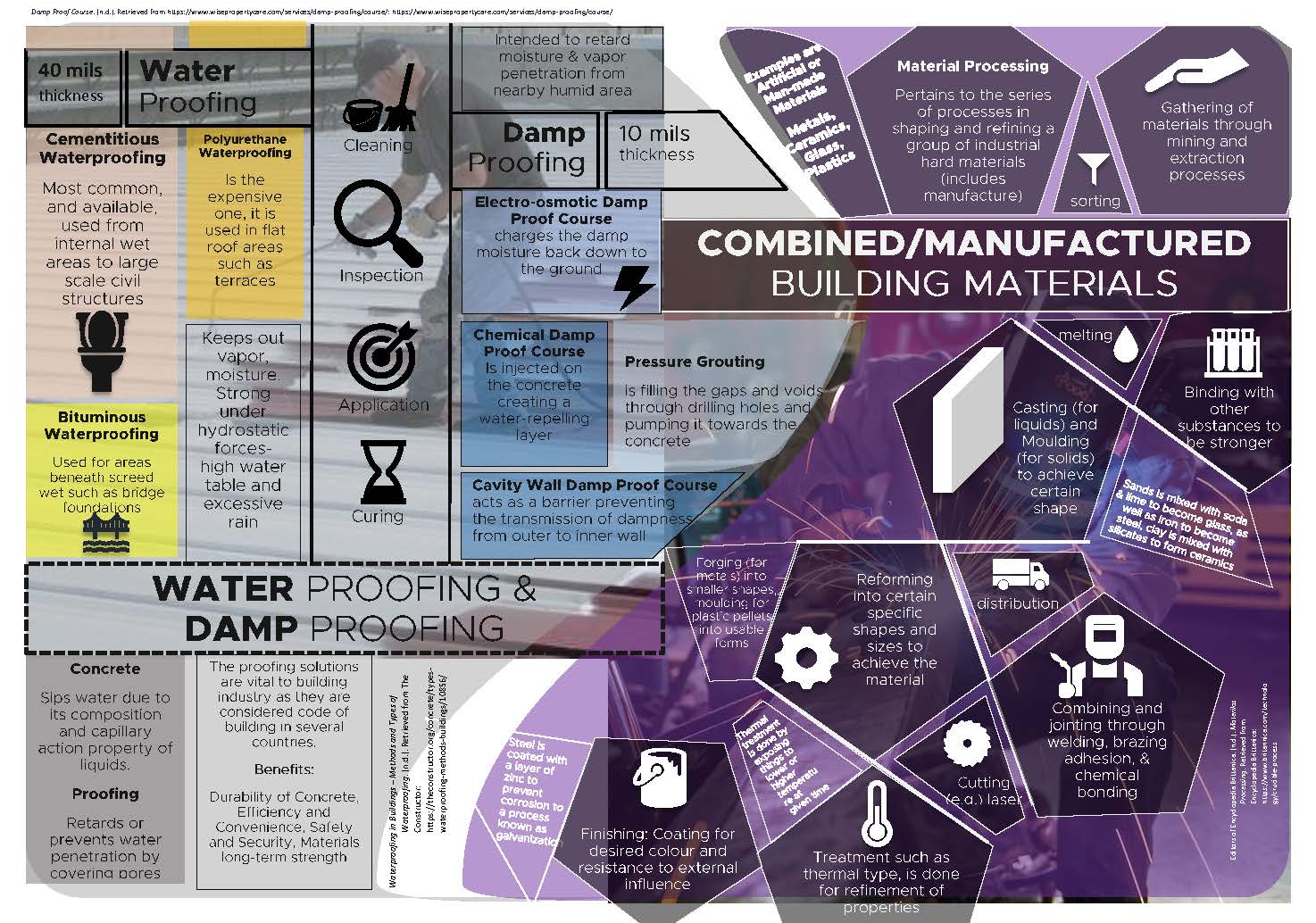
Waterproofing + Damp Proofing
Water and Damp Proofing are methods of applying solid-liquid substances to prevent, avoid and stop the penetration of moisture, water vapor and liquid water deep through surfaces. Water and damp proofs like adhesives are sometimes made of polymers, that have cement paste consistency which when dried serve as packed layer of membrane preventing water to sip inside the material (mostly concrete/hard cement).
Concrete is the common base in which proofing is applied. Concrete contains aggregate either fine or course bind to a base which is the cement paste a liquid- treated fine cement powder. The capillary action, a process which is a property of liquids lets it sip in the cement. With less water to cement ratio, there is greater water resistance on a concrete. The composition of concrete has an effect on its properties and how largely can it be affected by present factors both under different physical and chemical conditions.
Water and Damp proofing vary according to function and need. In terms of effect, water proofing prevents all kinds of liquid penetration including vapor and moisture, for its strength is adequate to areas where there is hydrostatic pressure from water. Hydrostatic pressure is the force of water applied over an area, directly relative to the increasing depth of water. Therefore, water proofing is applied to areas where there is a high-water table or exposed to excessive rain.
According to Constructor.org, waterproofing methods for buildings has five types: Cementitious Waterproofing used for internal wet areas or large scale structures, Liquid Waterproofing Membrane with high elongation properties and more flexible and applied using rollers or spray, Bituminous Waterproofing for areas beneath screed wet such as foundations, and the expensive Polyurethane Waterproofing for flat roof areas.
On the other hand, damp proofing primarily specializes in preventing vapor penetration from close contact soil that cause dampness of concrete. Unlike, water proofing damp proofing is not applied to areas under hydrostatic pressure, but is programmed to retard moisture passage by blocking pores on concrete.
The Wise Property Care stated types of damp proof courses: Electro-osmotic damp proof course which charges the damp back to the ground, Chemical damp proof course which is injected to serve as water-repelling layer, Pressure Grouting which fills gaps and void, Integral Wall which contains damp proofing beforehand, and Cavity Wall which acts as barriers to prevent transmission of dampness.
These applications are vital in the building industry, for they constitute in the durability and functionality aspect of the building. Without their applications there can be problems in terms of convenience specifically in the presence of moisture and liquid. They also serve as protection layers to the quality of interior building materials.
Combined/Manufactured Materials
These are a group of materials that are commonly identified as the artificial or man-made materials. As antonyms for raw or readily used materials presently available, these materials undergo a process which is termed by the Encyclopedia Britannica as Materials Processing. Material Processing is the general term for the sequence of operations that materials undergo for reshaping and refinement in order to be more suitable to their building purpose.
Industrial materials were defined as the hard materials: those that are used and can be reused because of their durable and usable properties. Examples of commonly manufactured materials are almost included in the group of Recyclable materials too, which are: Steel, Ceramics, Glass and Plastics and Polymers. The cycle of manufacturing process initializes after the harvest of raw materials, or production from chemicals. Materials like metals, are said to undergo beneficiation where concentration of the required raw material is increased through processes of grinding, roasting, floatation and separation to other materials through increasing temperature or magnetism, The next stage is a process of reinforcing the material by combining it with chemicals and other raw materials during their melted state in order to blend well with each other. In case of metals: smelting is the process by which lime and soda are melted with metal Iron to produce steel, which are almost the same additives to achieve soda lime glass, whereas ceramics is achieved by mixing natural clay and blended with various silicates, while plastics are produced by chemical methods that combine repeating polymer networks.
After these stages is the shaping of materials into desired size and shape, and the refinement through enhancing the materials’ properties. The forming of materials is said to be classified into two: casting - which involves the shaping of melted liquid metals, glass, and ceramics, and molding – which involves solid form of pellets like plastics. The molds are created depending on the desired pattern. After materials are molded, they solidify, and are removed from the mold, whereas when materials are in solid state they are exposed to force and pressure to be shaped.
Manufacture sometimes start with the delivery of these materials into company factories: metals which often start as bars and sheets are rolled or forged into smaller shapes. Plastic pellets are then melted on a mold to cast the desired form until it solidifies.
Cutting and Combining are sometimes the next stages for materials like glass and ceramics. Cutting can be in a form of electrochemical machining, manual cutting methods or laser machining. Combining or joining are done by attachment through processes of welding, brazing, adhesion and chemical bonding. Manufacture also includes treatments after the final form is achieved. Thermal treatment is the process which a material is exposed to higher or lower temperatures
to alter and enhance the property of materials such as durability and hardness. This mainly include the heating, holding at temperature and cooling.
Finishing is the final stage of these manufactured materials where chemicals are added to the surface through coating that improves the color and makes it more resistant to external factors such as corrosion for metals, or impact for glass and ceramics.
References:
- Damp Proof Course. (n.d.). Retrieved from https://www.wisepropertycare.com/services/damp-proofing/course/
- Editors of Encyclopedia Brittanica. (n.d.). Materilas Processing. Retrieved from Encyclopedia Brittanica: https://www.britannica.com/technology/crucible-process
- Waterproofing in Buildings – Methods and Types of Waterproofing. (n.d.). Retrieved from The Constructor: https://theconstructor.org/concrete/types-waterproofing-methods- buildings/10856/