Paints + Green Building Materials
03 February 2020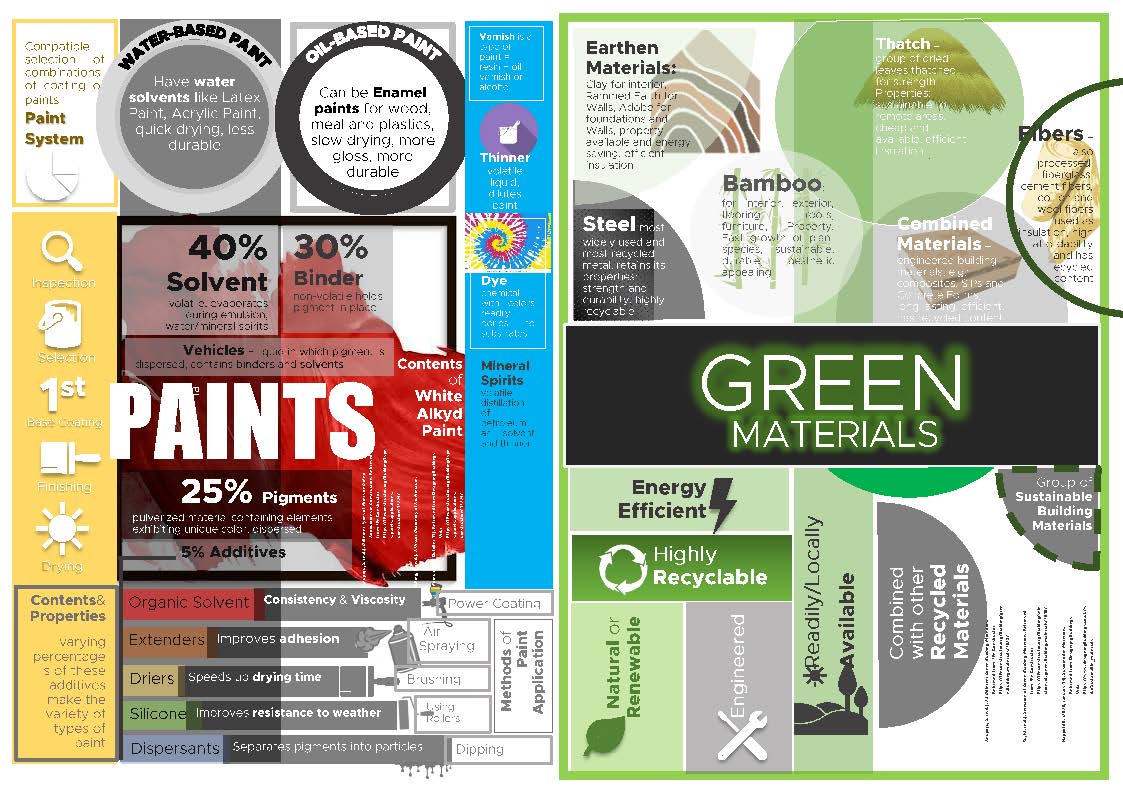
Paints
Paints are liquid colored substances applied on materials and surfaces covering it in a thin layer of coating. Paints are made out of pigments, and a base.
Pigments are in a form of pulverized powders which provide the color of paints. They are made out of organic and inorganic derivatives. These powders are mixed with liquid vehicle which contains binders and solvents. Binders, which is defined by Designing Building Wiki as a “polymer which forms a matrix holding the pigment in place” binds those pigments into a cohesive film. (Paint, 2019) Example of these binders are acrylic, alkyd, latex and epoxy polymers, which in turn produce the main types of paints: acrylic paints, alkyd paints, latex Paints and epoxy paints. Solvents on the other hand is defined by Ching as the volatile part of some types of paints that evaporates during the drying process. (Ching, n.d.) Other components such as organic solvent (manipulates the consistency and viscosity), extenders (improves adhesion and strengthens the film), driers (speeds up the drying time), silicones (improves resistance to weather), dispersants (separates and stabilizes pigment particles) and others are added to enhance the quality and manipulate the property of paints to be fit to the material. (Paint, 2019) There are several properties of paints that is matched to the need of the material to be applied at. These properties include: viscosity, adhesion, opacity, shine, flexibility, color stability, setting and drying time. Paints are generally manually applied with a brush or rollers, or by dipping and spraying: airless and electrostatic, powder coating.
Generally, the types of paints are classified into two: water-based and oil-based paints. Water-based paints also termed and described as latex paints and acrylic paints which have water solvents that evaporate during the emulsion, are easier to dry yet less durable. Cement-based paints are also water-based paints. On the other hand, oil-based paints which are termed as “enamel” are commonly used on plastics, timbers and metals because of the durable and glossy coating. types such as anti-corrosive paints are also oil-based paints. Another group of paints may also include: These paints often need water-based or oil-based primers before application. Types of finishes also vary from Matte, Satin to Gloss.
Paints are benefit for they cover surfaces that needs further protection from external factors. They are generally and are widely used because of their aesthetic contributions as decorations.
Green Materials
Green Materials are a group of a wide variety of building materials that helps in valuing the sustainability of the design, creation and existence of the space. The green materials can be described as sustainable, meaning they do not include the usage of non- renewable materials and their production and use has no detrimental effects on the environment.
Green materials are also achieved through several conservation actions of the builders or they fill several aspects of resource efficiency: natural and renewable materials, readily or locally available from the environment, their properties help in the conservation of energy such as durability and recycle property, innovated materials that are processed for lasting efficiency, manufactured materials with recycled contents, materials that may be in a closed loop of use to be reprocessed again if disposed. There are modern processes that helps further in the selection of these building materials, such as star-ratings for substitution of normal materials with more environmental alternatives, Eco-Point, and Carbon accounting. There are a wide variety of the characteristics of these materials, but all of which creates one or two benefits from the listed attributes above. (Happold B., 2020)
The Constructor listed about 23 of these Green Building Materials with each having a different and significant contributions to environment.
Earthen Materials like rammed earth, cob and adobe are widely used since ancient times for building a house, due to their availability, easy processing and direct application, and insulation properties. Natural fibers from plants when added to these materials will make it more durable as they serve as reinforcements to retain their form. Earthen materials like clay is also used for interior finishing of walls. Bamboo is a specie of grass known for its strength and durability. Bamboo can be used as framing and reinforcements for roofs, walls, floors and furniture. Bamboo grows fast so they are also economical to use, and their application does not need manufacturing. They are also used in the creation of various nipa huts across cultures.
Steel is the most widely used metal in the building industry for their known strength and durability. In fact, it is the most recycled metal for it retains its properties of strength thereby making it economical to use.
Thatch is all about dried leaves, straw and water reed. These materials are known to indigenous and remote areas for they are cheaply and readily available to be used in roofing which provides good insulation properties.
Combined Materials are the manufactured materials, engineered and tested for their innovative use and appropriateness to the field of building. Their constituents are
commonly characterized by recycled materials yet exhibits beneficial properties such as durability and insulation. SIPs or structural insulated panels are flake boards with a foam layer in between. Insulated Concrete Forms contains any two parallel insulation panels with space in between yet held by reinforcement bars. These are ideally used for walls t be poured with concrete, displaying strength and insulation properties.
Fibers and Bale are naturally occurring, manufactured or recycled materials in form of fibers or strands which are arranged in a form of soft foams that serve as insulation, sound-proofing, for non-load-bearing walls. Materials such as straw bale, fiberglass, cotton and wool batt are examples of these. Cement in a form of fibers with sand and wood can be good for exterior siding, with their affordability, durability and fire resistance. (Anupoju, 23 Different Green Building Materials, n.d.)
References
- Anupoju, S. (n.d.). 23 Different Green Building Materials. Retrieved from The Constructor: https://theconstructor.org/building/green-building-materials/7028/
- Anupoju, S. (n.d.). Different Types of Paints and their Applications in Construction. Retrieved from The Constructor: https://theconstructor.org/building/types-paints-applications-construction/17224/
- Ching, F. (n.d.). A Visual Dictionary of Architecture.
- G., M. (n.d.). Selection of Green Building Materials. Retrieved from The Constructor: https://theconstructor.org/building/selection-of-green-building-materials/7010/
- Happold B. (2020, January 14). Sustainable Materials. Retrieved from Designijng Buildings Wiki: https://www.designingbuildings.co.uk/wiki/Sustainable_materials
- Paint. (2019, October 11). Retrieved from Designing Buildings Wiki: https://theconstructor.org/building/types-paints-applications-construction/17224/