Metals + Non-Conventional Building Materials
20 January 2020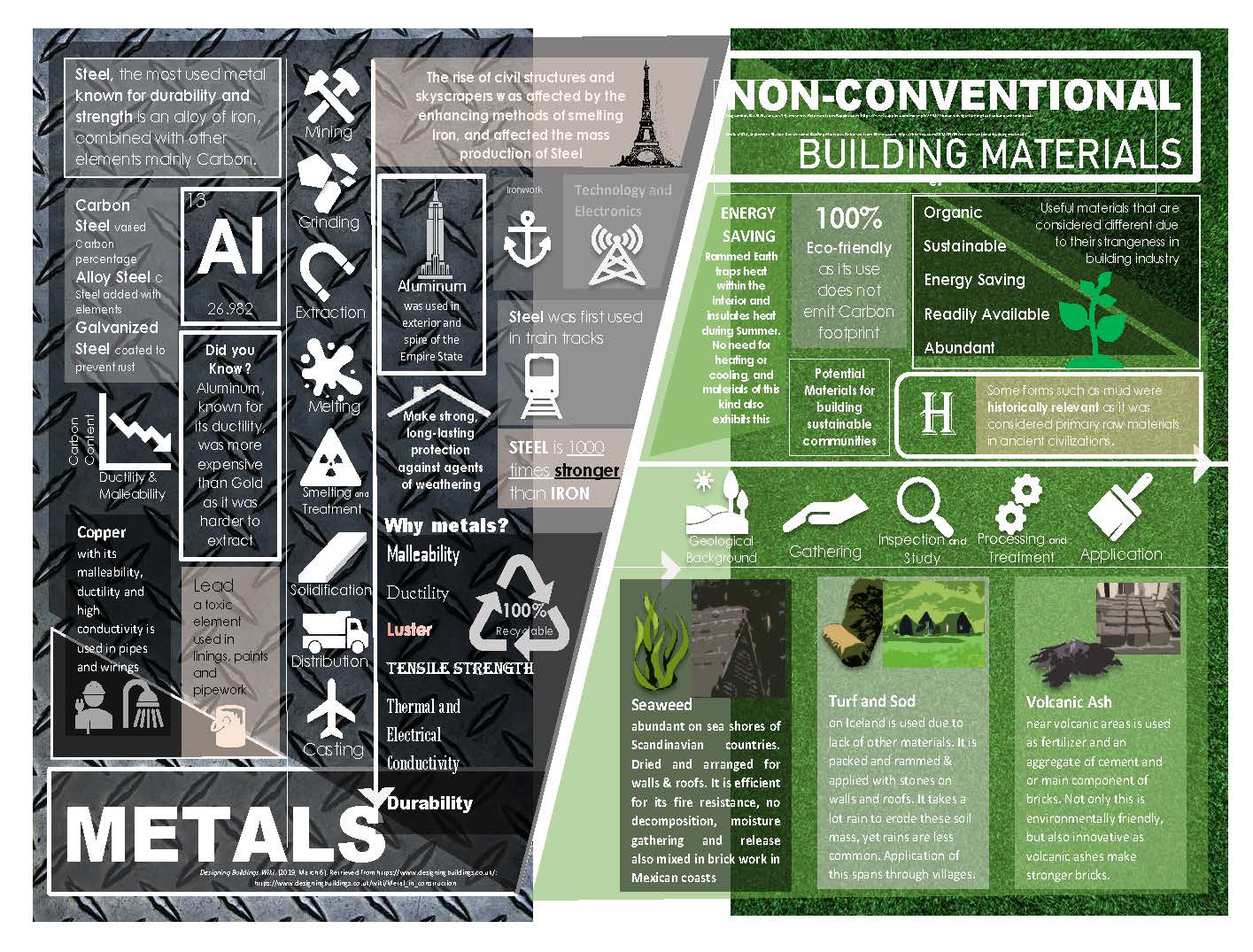
Metals
Metals are a group of metallic elements beneath the surface of Earth's crust, coexisting within rocks.
Metals come from mining a specific ore-rich geological area. Harvesting and extracting it as ores from the rocks through grinding and magnetizing. Ores like the element Iron are then melted with specific amounts of limestone and other chemicals that make it more capable to be used for structural purposes as steel. Steel is then shaped as bars of rectangular iron and cooled and then refined and flattened to form long sheets which are then rolled to be ready for distribution. These sheets are shipped to manufacturers of metallic products, who sometimes remake the process and refine the steel products, and shape and mold it in a desired form.
The main property of metals is that it has high electric and heat conductivity. It is harder and stronger than rocks and are more ductile and malleable which makes it truly useful in electrical components as wires. It also has a lustrous component making it shine. However, metals' weakness is corrosion, so metals like steel, are coated with chromium to prevent rusting.
Scientifically, metals that we use are classified as element or alloy. Elements are the purest state of metals like Iron, Magnesium, Gold, Silver, while alloys are achieved when they are mixed with other components to add in their durability or corrosion resistance. Metals vary according to use.
Iron, a natural occurring element is presently used as the base form of the alloy steel. It is relatively weaker, and non stainless, often softer in its natural form yet are smelted with other elements mainly Carbon. In its early years, Iron is used for weapon making. It us also classified in three types: Low Carbon Iron- like the wrought Iron which is a form used for handy ironwork due to its ductility. Medium Carbon Iron is relatively stronger and is used in structural purposes. High Carbon Iron like the Cast Iron - is strong yet brittle and less ductile. The higher the Carbon contents are, the less malleable and ductile the Iron becomes. Steel is an alloy made through reinforcing Iron with other chemical components. Steel is first used as train tracks and its manufacture dates back to Industrial Revolution and Late 19th Century where there is a rise of infrastructures and skyscrapers. Steel, therefore, is the strongest alloy thereby making it readily available, and cost efficient in structural purposes as framing foundations like beams and posts. It is also the most used metal as it can be up to 1000 times stronger than Iron. It can be classified in three main parts: Carbon Steel (which is Carbon infused), Alloy Steel (Carbon Steel infused with other elements for strength, corrosion resistance and durability) and Galvanized Steel (Steel coated with Zinc to be a protective layer against rust).
Aluminum is a non-naturally occurring and most abundant metallic element on Earth's crust commonly found bounded to other elements as a compound. It was more expensive than Gold before as its extraction was difficult. Thus, the discovery of an easier diffusion led to countless benefits in almost all industries. Due to its more ductile and more malleable property, corrosion stance and lightweight, many products in home economics, automobile, aerodynamics and architecture were made to be used such as foils, kitchen wares, car, plane and ship parts and gears, and also furniture and therefore making it the second most used next to steel. Copper is a highly conductive metallic element in which due to its ductility and corrosion resistance it is used in downpipe channels and eventually on electrical components and wiring. Brass is an alloy of copper.
Non-Conventional Building Materials
The non-conventional materials - are materials that are readily available and abundant, yet are oftentimes considered as unusual building materials for their strangeness to building industry. These building materials come from distinct and practical sources from the environment, which might be default sources of primitive building back then. Earth, turf and sod, and sand from the ground, seaweeds washed on shores of coastal areas. algae from lakes. These materials are widely available, ultimately usable, yet have not been used due to the trend of standardized cement on steel frames. The durable property of these building materials largely depends on the engineering and methods of their application. Factors such as proportions of mixture, choice of adhesives, drying time and material execution have significant effects on the effectiveness and accomplishment of the desired proper outcome. Earth mainly includes dirt soil, clay, gravel and sand combined in right proportions of mixture and poured in molds of plywood to be compressed, dried and hardened. Earth material is truly abundant, and its proper application leads to achieving the desired Tatooine-like structure, simple of aesthetic, practical of source, good insulation property and pest free environment. Turf and Sod are also Earth materials more common on northern coast of Europe and used as roofs by covering stones and wooden frames on houses' exterior Seaweed, an aquatic plant washed on shores is used as material for one story houses. It is harvested and dried enough to remove the moisture. Attached to cluster members using thick nets or adhesives, seaweeds can be strong sustainable materials as it makes a good insulation, is fire proof, and does not rot.
Algae is a green pigment tiny aquatic plant that can be used as tint in glass for window and roof glazing. Algae are stored within these glasses, and makes a good insulation to sunlight as they capture as energy.