Concrete + Hardware
20 January 2020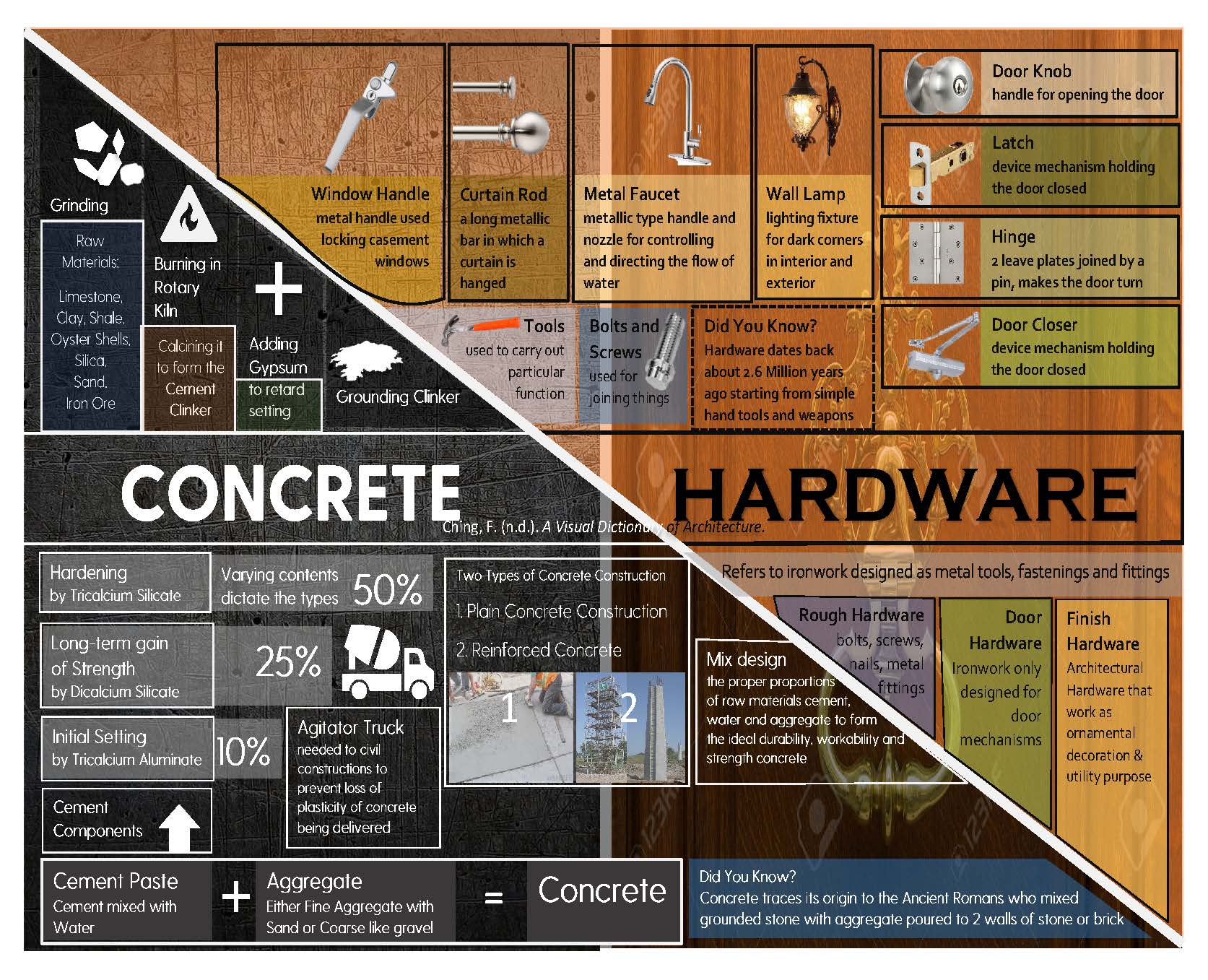
Concrete and Cement
Cement is a hard and strong substance, made out of pulverized stone parts, soda and lime that upon close contact and reaction with certain amount of water solidifies and hardens in a grey solid form. Cement traces its use in concrete building from Ancient Rome. Concrete is made by reinforcing cement with aggregate commonly gravel that strengthens the mix. Cement is one of the most widely used building material to almost all architectural and civil construction because of its availability, its easy transport, application, casting and long setting time therefore making it more practical to use than any material.
Cement types vary according to use. In its primary contents, cement is composed of three main chemical components: Tricalcium Silicate which is 50% and is responsible for the hardening, Dicalcium Silicate which is 25% and is responsible for the aging and long-term gain in strength, and Tricalcium Aluminate which is 10% and is responsible for the hardening. Varying proportions of these three dictate the type of cement to be yielded. “Cement is made from grinding limestone, clay, oyster shells, shale, silica sand and iron ore.” (Ching, n.d.) It is then inserted in a rotary kiln that calcinate it to become chunks of clinker, added with Gypsum retarding the setting and then pulverized into sandy cement powder. Cement comes in different types: ordinary Portland cement, rapid hardening cement, quick setting cement, low heat cement, Sulfate-resisting cement, air-entrained cement, and white-Portland cement.
Concrete, on the other hand, is added with either two types of aggregate: fine aggregate consisting sand and coarse aggregate commonly gravel. Concrete comes in types: lightweight concrete, weighing less than normal and insulating concrete, which has low thermal conductivity. Concrete is also desired to be at a mix design, where proper proportions are done to achieve the ideal property.
Concrete is also applied into two types: Plain Concrete Construction where no rods are attached within and Reinforced Concrete where it is reinforced with Steel rods for bending risks. Concrete making traces its origin from the Ancient Romans who first developed it along with reinforcement of stones. Concrete application also includes several equipment and machines like the flattening trowel, the edger, and the large scale pneumatic placement mechanism, and the agitator truck.
Hardware
Hardware are solid materials primarily used for tools to increase the convenience of the users. They were available in pre-historic times as weapons and simple tools, and can be traced back as far as 2.6 Million years ago almost near the stone and bronze age.
In the present time hardware come in wide range classified into categorized types. Domestic hardware are the closest to building materials, which may be sub-divided into 3 main categories: Rough Hardware which include the bolts, nuts, and screws that are used to join surfaces and joints, they also include the tools in construction made or a specified function. Door Hardware are ironwork fixture exclusively for openings primarily doors. These include the hinge, the door knob, the latch, the door closer and so on. Finishing hardware, on the other hand is used for decorative or utilitarian use in various interior design components.
Hardware are little components which has great simple mechanisms to provide more comfort and convenience in working.