Building Stones + Indigenous Materials
20 January 2020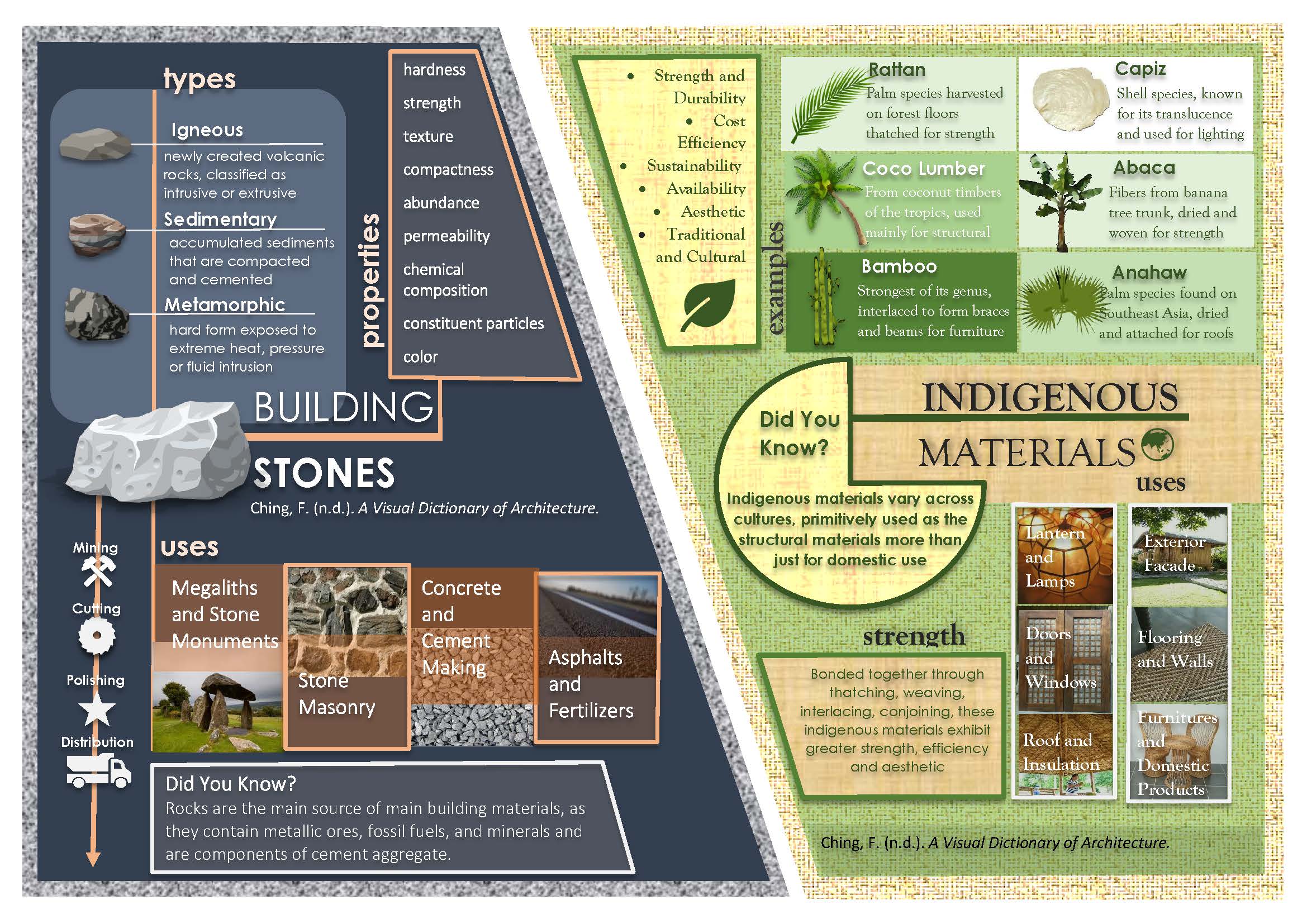
Building Stones
Stones are natural solid products from the Earth's crust undergoing different stages and containing elements like Nickel, Iron and Carbon.
Newly created rocks are solidified magma from open volcanic vents and hotspots, while several came from the pre-formation of the Earth. Rock's variation is made by gathering from its three different cycle stages: Igneous, Sedimentary and Metamorphic. Hard and enormous masses are common characteristics of the newly formed Igneous rocks: Granite, Basalts, Gneiss and Pumice. Smooth to rough pieces and smaller chunks, weathered and relatively weaker are attributes of the weathered, eroded and deposited Sedimentary rocks: Limestone, Sandstone. Hard, packed and layered are common to the Metamorphic Rocks which have undergone extreme heat and pressure.
Due to its wide presence, rocks have been an important part of building since the past civilizations. Rocks are present as instant sources to create massive tombs, temples and observatories such as the Megalithic Stonehenge in England, and it is also used as a main source of carving material. Rocks later had also been present as the main material in Greek temples in which Marble and Limestone is used. Stone masonry like Granites' also made it more useful in building fortresses, while cement making increased its demand in harvesting. Stone became available in almost all parts of building: walls, floors, terraces, towers, and even monuments. Today, stone is widely used as cement aggregate and as main materials of modern stone masonry.
The rocks hard, heavy, rough and smooth properties and abundance makes it more appropriate in the creation of several ancient infrastructures. Rocks' characteristics are also considered as a form of classical aesthetic in architecture.
Indigenous Materials
Indigenous materials are local or domestic raw materials that are only present and abundant to a cultural and geographic locations. These materials are identified as they are firsts to be culturally used by the native and primitive people on an area due to their strength and other significant characteristics. Indigenous materials today are treated as truly valuable materials for they represent the uniqueness of their local source.
Indigenous materials come from an abundant supply of the locality. It is commonly found in plants like coconut, abaca and rattan in the tropics. As truthful to the authenticity of cultural context, Philippines foe example is a main source of unique indigenous materials being located on a notable geological location.
Indigenous materials characteristics are exhibited in different ways. For example, plants like banana fibers, mainly used in clothing can display pressure resistance when woven, Rattan which with thatching, exhibits strength can be used in baskets to furniture. Other characteristics include durability (in plants), moldability (in clay), strength (in woods and bamboo).
Most of Philippines' indigenous materials are commonly and primarily used for clothing and accessories, domestic products like being, baskets, wallets, Salakot and Abanico, and simple architectural designs such as for thatching grasses for roof and weaving palm leaves for walls. Materials like bamboo can also be used in structural purposes such as the framing of the house.
Abaca Fibers are harvested from the heart of banana tree trunks and dried to be used in clothing Buri from a fan-like palm species are harvested as leaves, Rattan which is one of the hardest is also harvested from its palm species growing on forest floors. All of them, which exhibits durability when woven or thatched to each other can be subject to domestic uses and furniture like fashionable chairs. Stronger materials like Coco Lumbers and Bamboos are harvested as large trunks and stalks respectively are used for furniture and structural applications. Capiz, oyster shell is valued for its "durability and translucence", and it is used in windows and door frames. As these materials have an abundant supply in their local source, they are recognized to be sustainable building material for a certain region.
The common characteristic of indigenous materials is that its raw form is always seen in designs. The use of it in contemporary projects marks an identifiable trademark that represent a certain region as they are and can be available through ways of modern transportation.