Adhesives & Sealants + High-Tech Building Materials
20 January 2020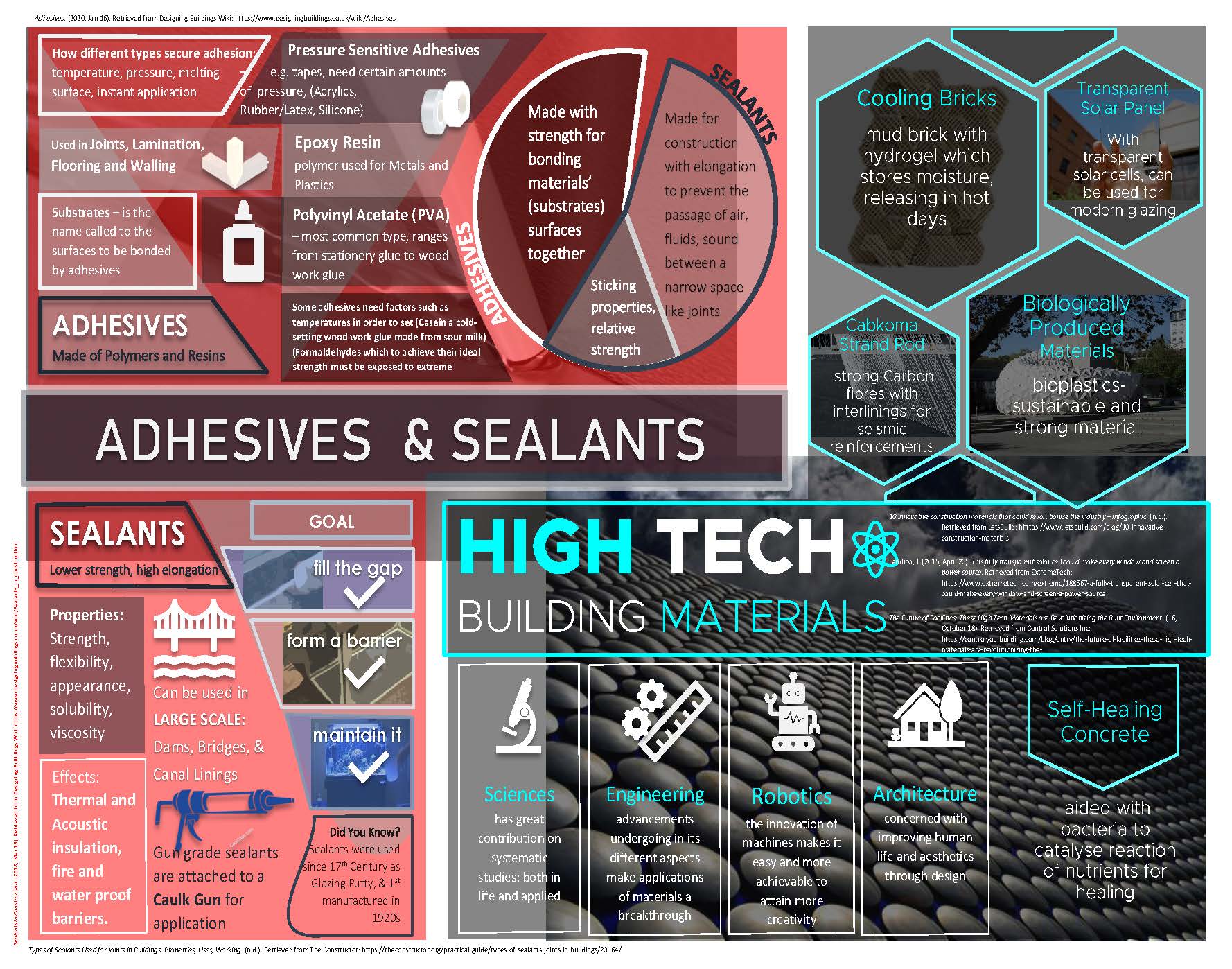
Adhesives and Sealants
Adhesives are binding substances commonly made of polymers and resins used for large areas, while sealants are substances used to cure small spaces, cracks or joints. Adhesives and Sealants natural binding properties made it easy for constructors in interior design, fixture installation, lamination and finishing.
Adhesives
According to Designing Buildings Wiki, Adhesives are used in carpet laying, ceramic tiles, countertop lamination, drywall lamination, flooring underlay, glulam, heating ventilation and air conditioning connections, timber jointing, roofing and wall coverings.
Polyvinyl Acetate is one of the most common adhesives, for its general application purposes. This type ranges from the ordinary white glue for papers to woodworking. It also has water resistant properties.
Epoxy Resin is an adhesive exclusively used for metals and plastics. It is sometimes combined to paints that are applied to the said construction materials.
Phenol Formaldehyde is an adhesive that requires a needed temperature as high as above 86 degrees Celsius to set. Besides these, adhesives are also found in chemicals poured on tapes and sticky notes, and for binding books onto their cover, and also to strong material adhesive such as superglues. Sealants
Sealants
Sealants cure joints that are exposes to mild to extreme stresses. The softer and flexible it is, the better the application and effectiveness, yet it should not be exposed to weather conditions like rapid heat to cold temperatures. The Constructor, listed four types of sealants, Silicone-based sealants used for glasses, Urethane-based sealants, Acrylic-based sealants and Polysulphide-based sealants.
Among the explained, Polysulphide-based sealants was explained as popular sealants in building industry. It is basically applied in cold temperatures, and is classified into two. The two-part system and the one-part system. The former includes a separate base and accelerator, which shall be mixed and applied within two days, and dried for a week and one day. This sealant can also be applied in ways depending on the type: pour grade and gun grade. The gun grade, needed for inclined, vertical and overhead joints, is done by pouring the sealant inside a cylindrical compressing gun and applied by
applying pressure on the lever. The one-part system involves a ready-mixed accelerator and base, absorbing moisture when applied which triggers the reaction, yet about a month will be needed for the full curing.
Sealants can also be used in large-scale building industry like joints in bridges and roads, and water-retaining structures like dams and reservoirs and canal linings.
High-Tech Building Materials
With the innovation of technology not only in hardware and robotics, the experts in different fields collaborated to every breakthrough and discovery with their contribution in their own field. With foundations in engineering, physics, biology, chemistry, architecture, new synthetic and artificial materials are accumulated.
High tech building materials refer to the new set, new generation of materials including the newly found raw materials and the enhanced and innovated existing ones. These new breeds of materials have the capability to ease out the existing problems in different aspects of living to develop more convenient solutions to reshape the human living conditions.
Cooling Systems in bricks are new sets of original clay mud brick but with the mix of a hydrogel. The hydrogel within the bricks have the capacity to trigger the storage of moisture from the surrounding environment which can then be released during long hot summers.
Self-healing concrete includes the main material concrete which happens with the reaction of the non-reacted limestone and calcium-based nutrient with the aid of a bacteria Bacillus that will help in healing cracks and fissures in the concrete. Biologically Produces Materials – among these is the creation of bioplastic furniture. Bioplastics is a by-product of combined biodegradable substance from renewable sources from oils, corn starch, recycled food wastes and are sometimes added with a mass of reprocessed disposed plastic bottles to form strong durable, and sustainable component.
Transparent Solar Panel is made from truly transparent solar cells which convert the photons from light into electricity. These panels contain Transparent Luminescent Solar Concentrators absorbing wavelengths of ultraviolet and infrared waves directed into the said solar cells. These panels, when demanded by the mass production, can turn simple glazing into energy-capturing windows.
Cabkoma Strand Rod is made of Carbon fibres within the interlinings, and with inorganic substance on the exterior and coated with thermoplastic resin. The Carbon fibre is the innovation, which aid the said strand rod for its high tensile strength and used in seismic reinforcements.